Doc Bar: The Halter Horse Who Changed Performance Breeding
In the last two articles, we looked at how inbreeding and linebreeding actually work, and why a repeated ancestor sitting in a pedigree isn't automatically good or bad on paper. Now it's time to meet one of the horses those decisions were built around, and to start putting names to the concepts we've been discussing. Doc Bar is a fitting place to start. He's our first true legend, a stallion whose influence still turns up in pedigrees generations later, often in breeding programs that never set out to find him.
Bred to run, built for nothing anyone expected
Doc Bar was foaled in 1956 on Tom Finley's Arizona ranch. He was by Lightning Bar, a son of the Thoroughbred Three Bars, and out of Dandy Doll by Texas Dandy. The breeding was aimed squarely at speed. What Finley got instead was a small, solidly built chestnut colt who was bred to run and failed. Across four starts, Doc Bar earned a total of $95.
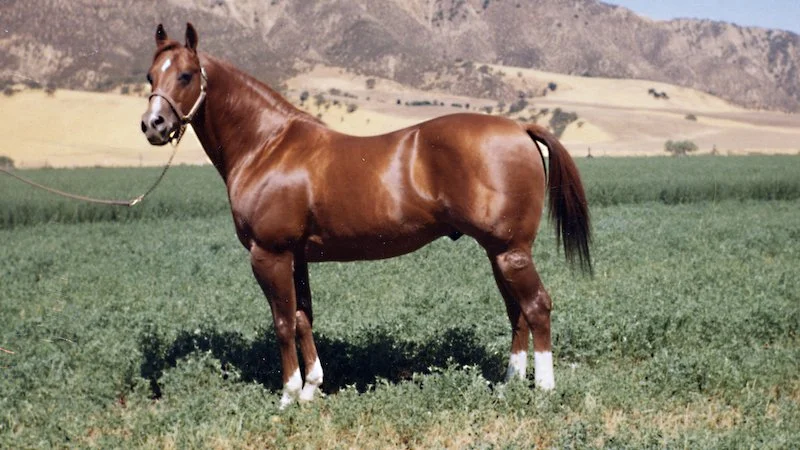
From there, he was given to Charley Araujo of California to show at halter, a career that looked just as unlikely to work. Doc Bar didn't have the polished, tightly put-together look that was winning in the ring at the time. What he did have was an older, heavier-boned build, closer to the original bulldog-type Quarter Horse the breed's founders had prized in horses like Poco Bueno and Joe Bailey, before a leaner style had come into fashion. Araujo saw value in that build and took a chance on it. Between his handling and a look that stood apart from the trend of the day, Doc Bar quickly proved that the prevailing halter type wasn't the only type that could win. Out of 15 shows, Doc Bar won nine grand champion titles and one reserve champion title.
Across four starts, Doc Bar earned a total of $95.
Why breeders went looking for him
Doc Bar's next chapter is less a story of luck and more a story of breeders actively seeking him out, and it started before the Jensens ever owned him. Dr and Mrs Stephen Jensen of Double J Ranch in Paicines, California, had already been breeding their own mares toward working-horse type, including mares bred to Poco Tivio, when Doc Bar's first foals arrived in 1960. Those foals made enough of an impression that the Jensens bought the stallion outright in 1963 for $30,000, a considered purchase built on results they'd already seen rather than a bet on an unproven halter horse.
Once they owned him, the Jensens kept his book deliberately small. Ranch manager Charlie Ward later said they never wanted to breed him to more than around 75 mares a season, preferring their own mares plus only a handful of select outside mares each year, rather than flood the market. His influence, though enormous, grew out of a relatively narrow base of under 500 foals across his whole career, spreading through the quality of what he produced rather than wide availability.
His influence, though enormous, grew out of a relatively narrow base of under 500 foals across his whole career.
The cross that changed the industry
One of Doc Bar's most significant crosses was with mares carrying Poco Bueno blood, and it produced results on both sides of his book. Bred to the champion cutting mare Poco Lena, herself a daughter of Poco Bueno, Doc Bar sired full brothers Doc O'Lena and Dry Doc, two of the most influential cutting sires to come out of his get.
Poco Lena's own story is worth a mention here, since it goes some way to explaining why those two colts turned out so well. She was a serious competitor in her own right, a five-time NCHA World Champion Cutting Mare, before a period of severe hardship in the early 1960s ended her career. She recovered enough to be bred, though it took three seasons before she carried a foal. Doc O'Lena, born in 1967, was that foal. Her second and final foal, Dry Doc, followed the next year, and she died not long after. Two foals, out of a mare that good, both by Doc Bar, both NCHA Futurity Open Champions. Her full story deserves more room than we can give it here, and we'll pick it up properly in the Poco Bueno article, since it says as much about that line as it does about this one.
Two foals, out of a mare that good, both by Doc Bar, both NCHA Futurity Open Champions.
A separate branch of the same cross ran through Poco Tivio-line mares. Teresa Tivio, a daughter of Poco Tivio, produced both Boon Bar and his full sister Fizzabar by Doc Bar. Boon Bar went on to sire Royal Blue Boon, a mare who became one of the breed's most influential broodmares in her own right, and whose son Peptoboonsmal (by Peppy San Badger) we mentioned back in our article on inbreeding and linebreeding as an example of collateral linebreeding. Since Poco Tivio was himself a son of Poco Bueno, both branches of this cross trace back to the same foundation stallion, a thread we'll pick up again when we reach the Poco Bueno and Royal Blue Boon articles.
Sons and daughters who kept producing
Doc Bar's own show results mattered less over time than what his offspring did with theirs. Doc O'Lena won the 1970 NCHA Futurity Open Championship, and his full brother Dry Doc won it again the following year in 1971, back to back titles for two full brothers who were their mother's only two foals. Fizzabar and Doc's Kitty went on to shape performance breeding in their own right too, well beyond their own careers in the show pen.
Charlie Ward, who managed the Jensens' ranch, put it simply: Doc Bar's colts were consistent in type, uniform, sensible and easy to train, with natural cow ability across the board. That consistency, more than any single result, is what breeders mean when they say a stallion breeds on. It isn't just about producing good individual horses, it's about continuing to produce sires and dams who go on to be foundational themselves.
That consistency, more than any single result, is what breeders mean when they say a stallion breeds on.
A name that keeps appearing
Doc Bar was also the grandsire of Smart Little Lena, Tenino San, Docs Sangria and Don N Willy. We're only naming these connections lightly here. Smart Little Lena, through his sire Doc O'Lena, will get his own deep dive later in this series, as will the High Brow Cat lineage that follows from him. For now, it's enough to notice how often the name Doc appears a generation or two back in a modern performance pedigree.
What the bloodline contributed
Consistency of type and temperament is the clearest thread running through Doc Bar's influence. His offspring and grandget are commonly associated with natural cow sense, athleticism suited to cutting, and a trainable, sensible disposition that made them easy to bring on. It's this combination, more than any single champion, that's credited with reshaping what breeders looked for in a performance-bred Quarter Horse.
Why it matters in modern breeding
Doc Bar sired a relatively small number of foals for a stallion of his influence, around 485 over a 19-year career, since demand for his book always outpaced what he could cover. Despite that limited number, his name has stayed remarkably current. In 2019 alone, AQHA pointed to champion titles across cutting, reined cow horse, reining and rodeo, all won by horses tracing back to Doc Bar, as evidence that his influence hadn't faded even decades after his death. We couldn't find a solid, sourced percentage figure for how many registered Quarter Horses carry him overall, so we've deliberately avoided inventing one here. What is well documented is that his descendants have kept producing at the top level, generation after generation, which is a large part of why his name still surfaces so often in pedigree research.
How Cadence interprets it
Every mare currently in our broodmare band traces back to Doc Bar, each at a different distance. Hope carries him across eighteen separate crosses, the deepest concentration of the four. Immy carries him further back, through Poco Navy Bar, a Doc Bar son crossed onto a Poco Tivio daughter, the same nick discussed above, and she's been producing well to cow horses as a result. Reba and Lashes both carry him too, at their own respective distances.
We didn't go looking for Doc Bar when we put this broodmare band together. He turned up on his own, at very different distances, because he sits so deep in ranch and performance-bred Quarter Horse stock, which is exactly why he's a fitting horse to open this part of the series, the first of the legends we'll be exploring.
Practical breeder takeaway
A stallion's own record tells you less than what happens two or three generations after him. Doc Bar's four unremarkable race starts say almost nothing about his impact. What he produced, and what his offspring went on to produce themselves, says everything. When you're assessing a bloodline, look past the individual and ask whether the influence holds up over time. That's the real test.
A stallion's own record tells you less than what happens two or three generations after him.
Coming next in this series:
→ Poco Bueno: More Than Just a Foundation Name
→ Pretty Buck and the Older Foundation Threads
→ Smart Little Lena and the Rise of Modern Cutting Blood
Footnotes / references
AQHA, "Doc Bar", American Quarter Horse Hall of Fame biography, aqha.com/-/doc-bar
AQHA, "Doc O'Lena", American Quarter Horse Hall of Fame biography, aqha.com/-/doc-o-lena
AQHA, "Smart Little Lena", American Quarter Horse Hall of Fame biography, aqha.com/-/smart-little-lena
AQHA, "The Doc Bar Influence", aqha.com/-/the-doc-bar-influence
Western Horseman, "The Story Behind Doc Bar" and archived Doc Bar feature, westernhorseman.com